
-
The process is a study in noticing the night as a collection of atmospheres—hues, natural phenomena, artificial disruption—that hold the capacity to shift time itself. Over the last several years, paintings began to carry subtle characteristics of atmospheres in flux or held in transitional pause: layered abstractions tracing emotional arcs.
Four canvases, each at a point that could be considered complete, are selected and photographed; the image becomes evidence of an existence already receding. The canvases then return to the easel (the night is also a reset) to be reworked until reaching another moment of perceived emotive completion, where they are again photographed. This process is repeated, distilled; work is made sequentially but not paired or presented as such. In this practice, time has a way of being gathered and sorted rather than linear. This practice forms a temporal/visual palimpsest—adjunct surfaces in simultaneous becoming and vanishing, creating a single, heterogeneous field where no moment is truly separate or final.
-
As a visual duet, these works orchestrate dusk enveloping shadow—a faint emergence, a breaking through. The paired prints mirror lavender atmospheres fading into night rainbows. These works create a vibration between body and spirit—an entrance into esoteric space rather than a departure from light.
These printed images are not reproductions. Each is an impression captured at a moment that could be considered complete — before the canvas returned to the easel. The painting moved on. The print material is what remains: evidence of an existence receding, an atmosphere held at the exact point it began to dissolve.
This body of work accrues nonlinearly from many night inquiries at once. To offer context, I begin with the atmosphere I first recognized as the gateway to this practice.
Nocturne pairing: Frédéric Chopin’s Op. 15, no. 1, F major
-
Maybe I miss the night. To be more specific: in this relocation to New York City from my retreat in Louisiana—where streetlights are nonexistent—I have noticed. My body has noticed. As a creature with a preoccupation for light, I quickly understand that in the city occupied by buildings and shadows, there is neither ever a full sense of darkness nor the presence of consistent daylight. This disequilibrium confuses me for months.
I have been thinking about this print work for a long time, as a body that could accumulate into a large-scale piece. Having kept a collection of notebooks over the course of many years, versions of this sketch reappear in more than a dozen iterations. I've tried to work it in but the time/space was never right. This idea returns to my practice as I arrive in New York. I sneak out in the evenings to see performances. In my younger years, I was not a painter. I loved art, of course, but most of my adolescence was spent enthralled by the stage—in both dance and theater. In this return to the city, a mission has been to immerse myself in the sensation of as many theatrics as possible, and something about this fulfills my need to interact with a version of night. I make most of my trips to shows solo, because just like traveling alone, my senses are more attuned. This focus allows each composition to absorb trains of thought, temporal memories, and I think of it as divine research time. That said, please do consider inviting me to performances (theater, music, dance, jazz, etc.)—I'm nothing if not a gracious and available date.
One evening I was slipping onto the subway leaving Lincoln Center following a gorgeous collaborative work. I began to consider the themes in my practice that could enter into dialogue with classical music: time, grief, transition, maternal care (at all hours), dreams, safe contemplative spaces (and why we require them now), the Romantic poets (Baudelaire's grotesque Les Fleurs du Mal), light, the phenomenology of prismatic atmospheres, natural evening bloomers—from the queer and sequined to exotic botanicals rising from mud—all at the behest of the night. The word Nocturnes dropped in as a framework. Themes started to separate themselves into duets—some that are in sync and some not at all. My large-format print practice was not only a process, it also became a container for a research.
I have been studying the historical nocturne in music—first pioneered by John Field and later elevated by Frédéric Chopin—as sonic refuges created alongside atmospheric studies of night. The nocturne pieces (first marketed as domestic music with the accessibility of a home piano) offered contemplative space where melancholy and unrest could unfold; their rhythms create passage for inner time to stretch. In our present existential climate—marked by uncertainty, isolation, accelerating change, and ecological precarity—this study forms an echo of that tradition. Successive layers veil and reveal fragile atmospheric truths, much like the way buried histories, repressed or lost ecosystems, and grief travel beneath contemporary surfaces. The palimpsest becomes a visual meditation: time doesn't actually disappear; it haunts, reshapes, and extends itself as co-existence.
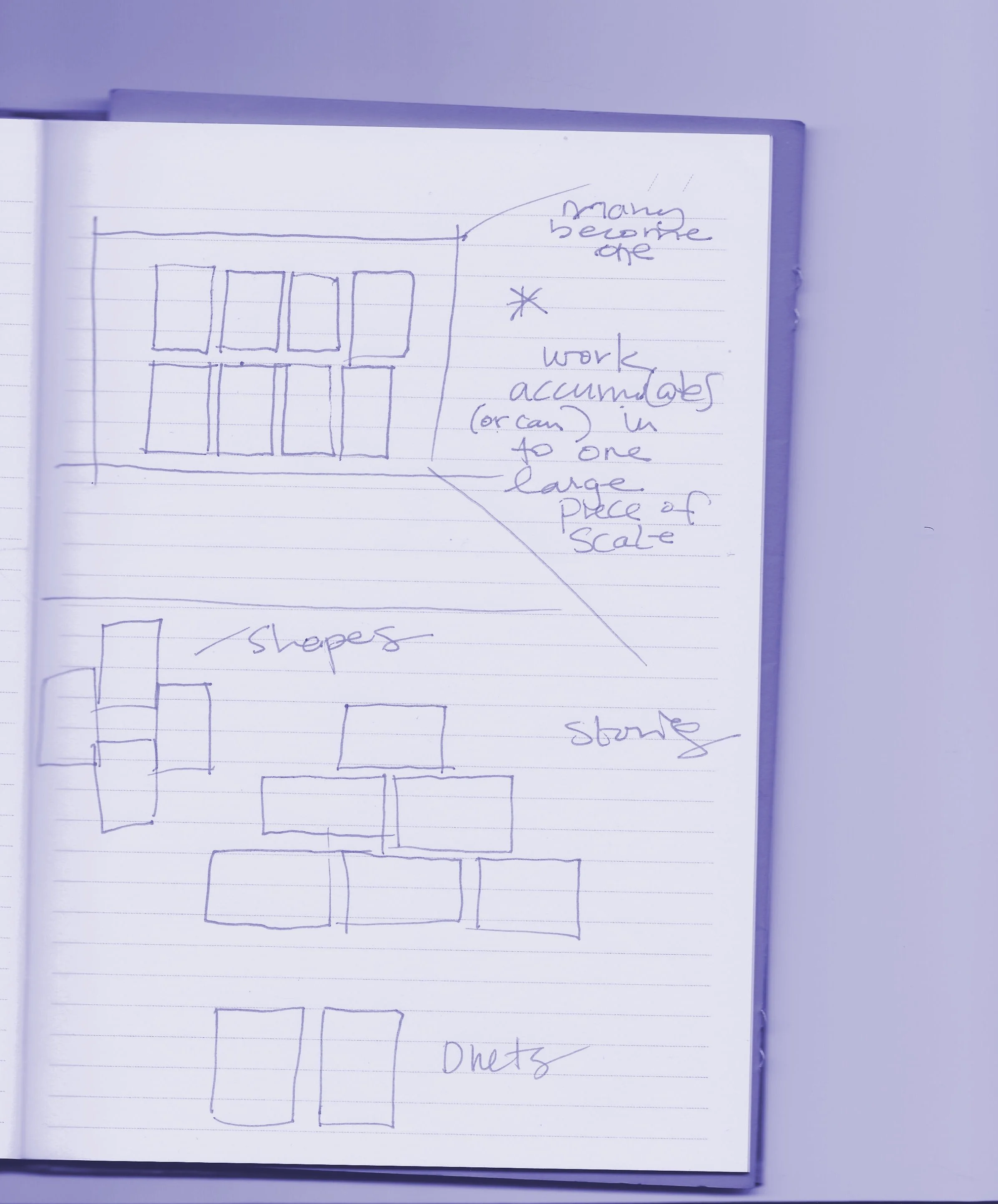
*sketchbook note, from Artist Statement No. 1